AFT Price was built from a very practical problem at Air Filtech: how could the sales team get pricing, technical specifications, drawings, and product documents faster without depending on engineering for almost every request? Before the system existed, a non-standard product usually had to go through several steps. Sales received the customer requirement, passed it to engineering, waited for the drawing to be processed, and only then had enough information to break down the price. In some cases, waiting for the drawing alone took almost a week.
For standard products, the situation was somewhat simpler because some prices had already been prepared, but the data was not truly centralized. Different people could keep different versions, while material input costs, labor costs, and sales strategy changed over time. Management could announce updates in meetings or communicate directly, but if just one person forgot to update their own file, sales could easily use an outdated price.
AFT Price was created not simply to put a spreadsheet on the web. The larger goal was to bring pricing logic, product data, the drawing library, technical documents, and project history into one system so that the knowledge Air Filtech had accumulated over many years could be used faster and more consistently.
The hardest problem was not calculating price, but knowledge being scattered across many places
In a technical business, product pricing is not simply the purchase price plus a fixed percentage. A piece of equipment may change in dimensions, material, configuration, accessories, or fabrication requirements. The underlying cost can therefore involve many types of materials and multiple labor stages. When the inputs change, the calculation also has to change.
Before AFT Price, Air Filtech already had Excel files for pricing. These files actually contained a great deal of valuable knowledge because they held not only numbers but also the way the company had built pricing logic for each product group. The problem was how these files were managed and distributed. When data existed in multiple copies, making sure the entire sales team was using the same version became difficult, especially when prices needed to be updated frequently.
Instead of discarding everything that already existed and rewriting it from scratch, AFT Price reused the calculation logic in the old Excel files. Pricing data was converted into encrypted .enc files for use in the system, while updates to these datasets were restricted to management or authorized users. This meant that when material prices, labor costs, or business policies changed, the responsible person could update one centralized data source instead of asking every salesperson to edit their own file.
This was one of the most important aspects of the project: the software did not eliminate the company’s existing knowledge; it turned that knowledge into a more controlled data source.
Sales only enters parameters while the system handles the complex logic behind the scenes
For products that were not completely standard, salespeople previously could not simply open a price list and choose a product code. They had to provide parameters to engineering, wait for a suitable solution, and only then continue to the pricing step. As project volume increased, this dependency not only forced sales to wait, but also caused engineering to spend a great deal of time on requests whose logic was relatively repetitive.
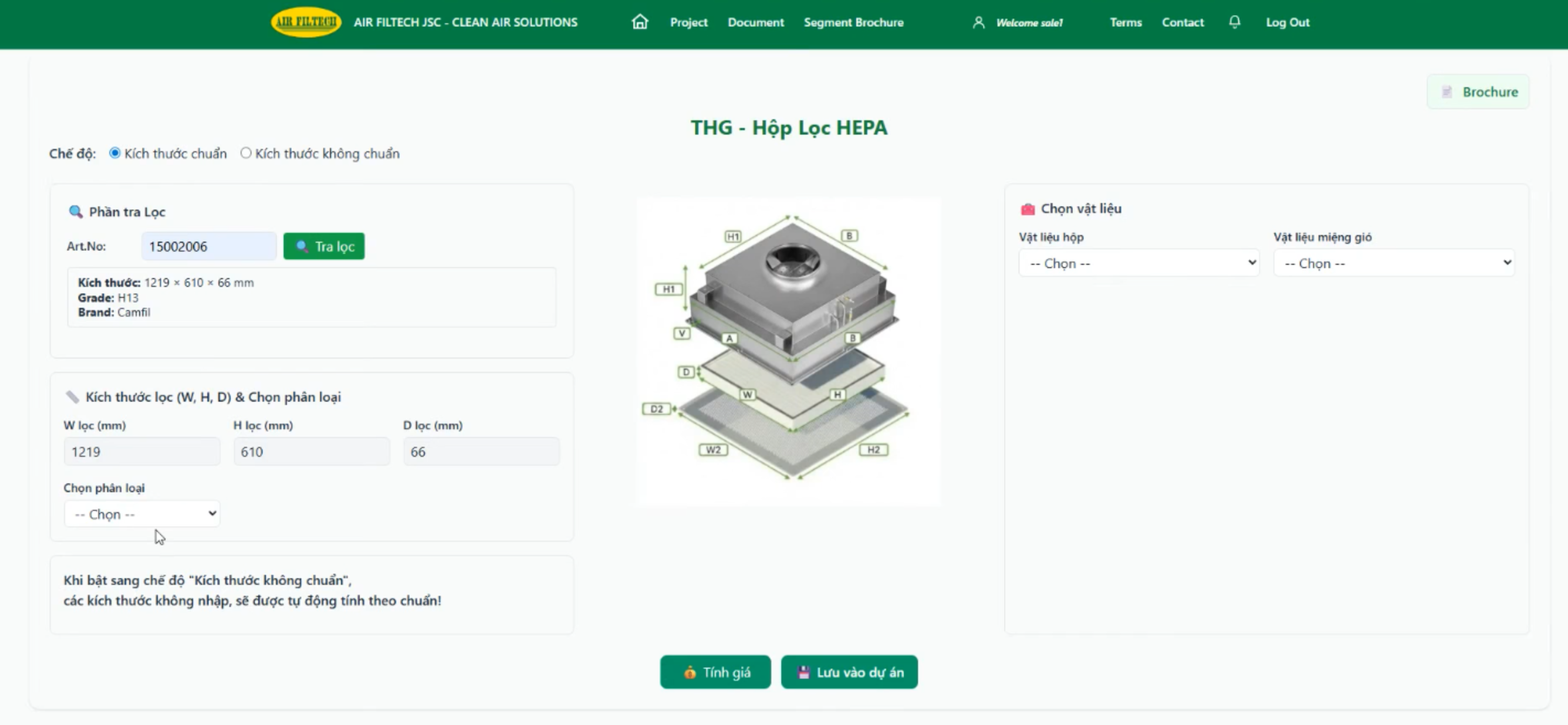
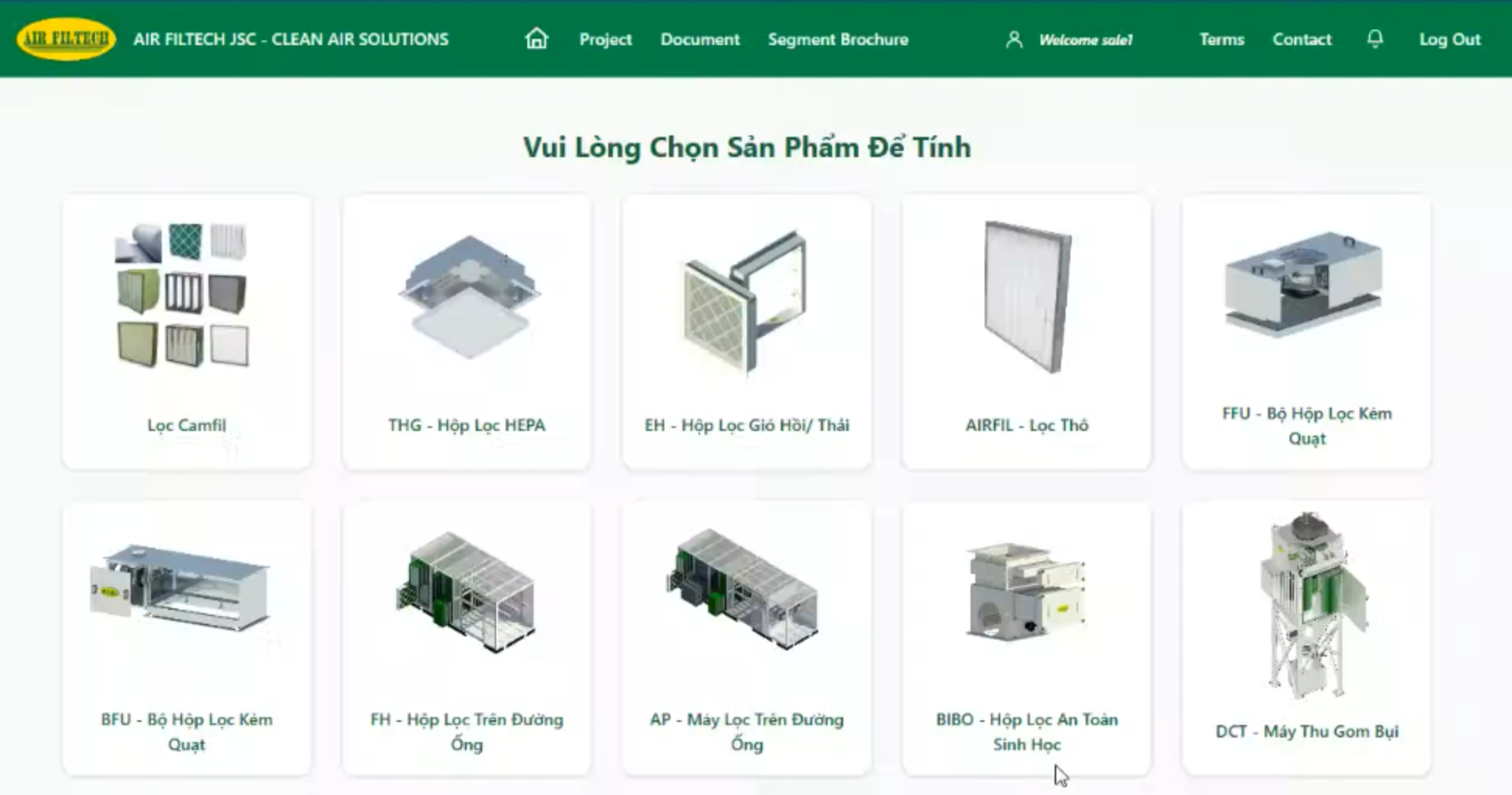
AFT Price moved the logic that could be standardized into individual product modules. Users select the correct equipment group, enter the required input parameters, and the system processes them to return the corresponding result. In the current product structure, AFT Price includes multiple modules for groups such as HEPA filter boxes, pre-filters, FFU, BFU, duct filter boxes, fan filter units, BIBO, dust collectors, PASSBOX, AIRSHOWER, SAFEAIR, ESP, and other equipment groups.
The important point is that each product group is not forced to use one common parameter set. Users move from the product library to the correct calculation module for the equipment group they need to process. This allows the front-end experience to remain simple for sales while the complex calculation logic stays behind the scenes.
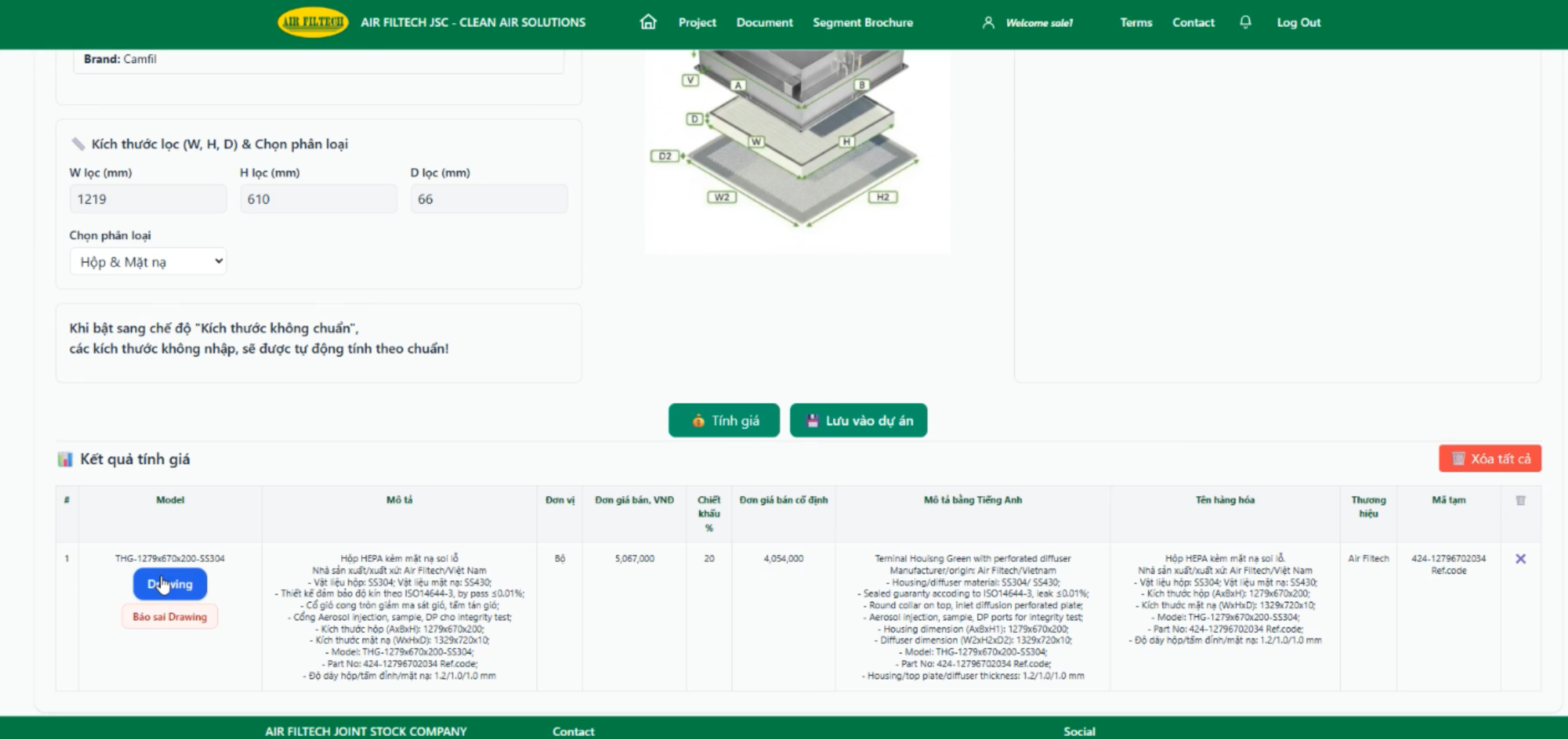
Once the input parameters are complete, sales can receive the model, price, and discount level being applied according to the data updated by management. A task that previously had to move back and forth between sales and engineering for several days can be completed in a few seconds for cases that have already been standardized in the system.
Two years of standardizing the drawing library only creates full value when sales can retrieve the right drawing exactly when needed
Pricing solves only one part of the consulting process. With technical products, customers often need drawings, specifications, and documents for review before making a decision. Previously this was another dependency on engineering: sales had to send a request, engineering had to find or prepare the drawing, and then send it back. When many projects were being handled at the same time, even a seemingly simple request could take a long time.
The Air Filtech engineering team spent around two years standardizing the product drawing library. AFT Price directly uses this asset by linking drawings to product results in the system. When sales enters parameters and the system identifies a suitable model, the related drawing can appear immediately in the same lookup flow instead of requiring another request to engineering.
It is not only drawings. AFT Price also includes a document area, segment-based brochures, and the ability to display drawings related to the result. Within the same workflow, sales can view the model, technical description, relevant information fields, drawings, and brochures to prepare for customer discussions.
This is where the value of the technical library changes completely. Even a very complete library has limited value if only a few people know where to find things. Once it is connected directly to product logic, the knowledge the engineering team spent years standardizing can reach sales at the exact moment it is needed.
AFT Price does not only return a price; it returns a “product profile” that gives sales enough information to continue working
If the software only returned a price, sales would still need to look elsewhere for everything else. AFT Price was built so that the result of one configuration contains multiple layers of data: model, relevant technical information, price, discount, drawings, and reference documents. This means the lookup process does not stop at the question “how much does this product cost?” but moves closer to “what do I need to advise this product for the project?”.
This is also why the system fits a product portfolio with many different equipment groups. Each module still has its own logic, but the final results are brought into one consistent experience for the user. Sales no longer needs to remember which engineer keeps which file or which folder contains a brochure; the software becomes the starting point for accessing product information.
However, AFT Price was not built as a system that automatically issues an official commercial quotation. Product documentation confirms that it is a tool for configuration and pricing data; the final value still has to follow the company’s consulting and approval process.This is especially important for projects with special commercial conditions or cases that require management review before being sent to the customer.
A pricing calculation does not disappear when the screen is closed; it can become project data
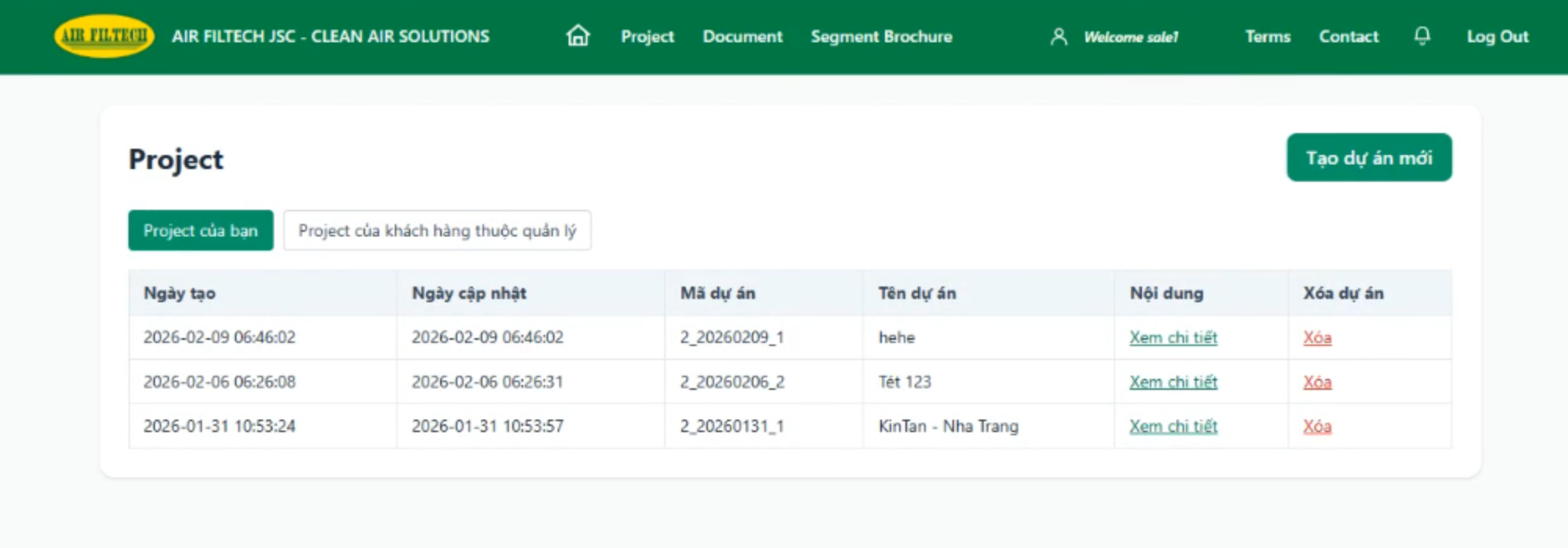
One of the most important parts of AFT Price is that calculation results do not exist only at the moment the user completes the calculation. Sales can add the result to a new Project or an existing Project, then reopen the project later to review the saved product lines. This is also a function confirmed directly in the current product.
The value of this becomes clear only over a longer period of time. A project may receive a quotation today but return one or two years later. At that point, the business needs to know which model was previously selected, which price was used, and what data was behind that quotation. If everything exists only in personal files or in the salesperson’s memory, reconstructing that history becomes very difficult, especially if the previous owner has left the company.
When data is stored by Project, the system becomes a historical record. Authorized users can go back and review which products were calculated for the project, the price at that time, and the related information. For management, the value is not only knowing “which project is sales following?” but also being able to see exactly which solution the business previously proposed for that project.
This also turns AFT Price from a calculation tool into part of the business memory. What was done in the past does not disappear simply because someone changes computers, changes files, or leaves the company.
The same data needs to show different things to sales, management, and the workshop
Another special aspect of AFT Price is that the data behind a product does not serve sales alone. The selling price on the front end is the final result sales needs to continue working, but inside a product there are also components that management or production may care more about.
Based on how the system is used, the workshop supervisor or another appropriately authorized user can view deeper cost-structure data, including material BOM and labor breakdown by stage. Sales, meanwhile, does not necessarily need to see this entire layer of internal data. Permissions allow the same product to serve multiple roles while each person only accesses the information appropriate to their work.
This is very different from sending one shared pricing file to the entire company. When one spreadsheet contains selling prices, material costs, labor, and other internal information, it is very difficult for the business to control who can see what. In a permission-based system, the data can be centralized while access rights are still separated by role.
AFT Price currently includes login, user and customer management, an administration area, activity audit, and two-factor authentication flows. These areas are less visible than the pricing screen but are essential once the tool becomes a system that contains the company’s pricing and project data.
Excel is still kept for the steps where Excel remains useful
Custom software does not necessarily have to replace every tool the business is already comfortable using. In AFT Price, results can be exported to .xlsx files for further consolidation, processing, or sharing when needed. Markdown đã dán (1)
This fits the reality of engineering and sales teams. There are parts of the work where Excel remains fast, flexible, and familiar. Instead of forcing users to perform every action inside a closed system, AFT Price focuses on the areas where software creates the most value: standardizing logic, using the correct current data, organizing information by Project, and creating one common source of information. Users can still take the data out to Excel afterward if the downstream process needs it.
The difference is that Excel now becomes the output of a controlled data source, rather than each person maintaining their own spreadsheet and gradually creating multiple inconsistent versions.
The greatest value of AFT Price is bringing Air Filtech’s technical knowledge into a reusable system
Viewed feature by feature, AFT Price can be described quite simply: select a product, enter parameters, calculate the price, save the project, view drawings, open brochures, and export Excel. But looking at it that way misses the most important part of the project.
Behind AFT Price are years of Air Filtech building pricing logic, standardizing products, breaking down materials, defining labor, and creating a drawing library. Previously, that knowledge existed in files, in individual experience, and in the communication processes between sales and engineering. The software did not create that knowledge for the company. It turned the existing knowledge into a system that more people can use faster and more consistently.
Sales can independently handle many standardized cases without waiting for engineering for every request. Engineering can reduce repetitive work and focus on cases that genuinely require expertise. Management has one place to update pricing logic and discount policy. Old projects can be reopened years later to review history. Drawings that the engineering team spent years building no longer sit as a passive library; they are delivered to the correct product when users need them.
Current AFT Price documentation confirms that the system includes calculation modules by product category, Project saving, Excel export, documents and brochures, drawings, login, administration, audit, and 2FA. But the value of the project does not come from the number of features. It comes from how those parts are connected to solve a very specific Air Filtech problem.
AFT Price does not only make one calculation faster. It turns pricing data, product knowledge, drawings, and project history into a reusable digital asset across the business.